
The Partner Marketing Gap Costing B2B Companies Revenue
B2B marketing teams have built sophisticated infrastructure for every major channel. Marketing automation platforms handle demand generation. Content management systems power SEO strategies. Analytics tools track performance across paid, organic, and event channels.
But for partner marketing? Most companies have nothing.
No discoverability infrastructure. No attribution model. No way to turn partner ecosystem relationships into measurable marketing assets.
This infrastructure gap is costing B2B companies measurable revenue. Research from Forrester shows that 67% of companies expect their partner-influenced revenue to grow significantly, yet most marketing teams cannot measure which partnerships actually drive pipeline.
The problem isn't that partnerships lack value. The problem is marketing hasn't built the infrastructure to capture that value.
Why Partner Marketing Became Marketing's Problem
For years, partnerships operated as a relationship management function. Partnership teams negotiated deals, managed co-selling motions, and reported on ecosystem health. Marketing's role was limited to occasional co-branded content and joint webinars.
That model worked when partner programs were supplementary to core go-to-market strategies. It doesn't work anymore.
Your Ecosystem Is Now Part of Your Value Proposition
The fundamental shift in B2B buying behavior changed everything. Modern buyers don't evaluate solutions in isolation. They evaluate ecosystems.
When prospects research your platform, they specifically look for:
Integration capabilities with their existing tech stack
Partner ecosystem depth and maturity
Compatibility with tools they already use
Verified integrations and use cases
A platform with 50 integration partners isn't just more connected than one with 5 partners. It's fundamentally more valuable to buyers. More flexible. Less risky. Easier to adopt.
But if that ecosystem is invisible to prospects, you get zero competitive advantage from it. Your competitor with a visible, searchable partner marketplace looks more mature, more connected, and more trustworthy. Even if your actual partner program is stronger.
That's a positioning problem. And positioning is marketing's responsibility.
The Cross-Functional Alignment Challenge
The organizational complexity compounds the infrastructure problem. Effective ecosystem-led growth requires alignment across five critical functions:
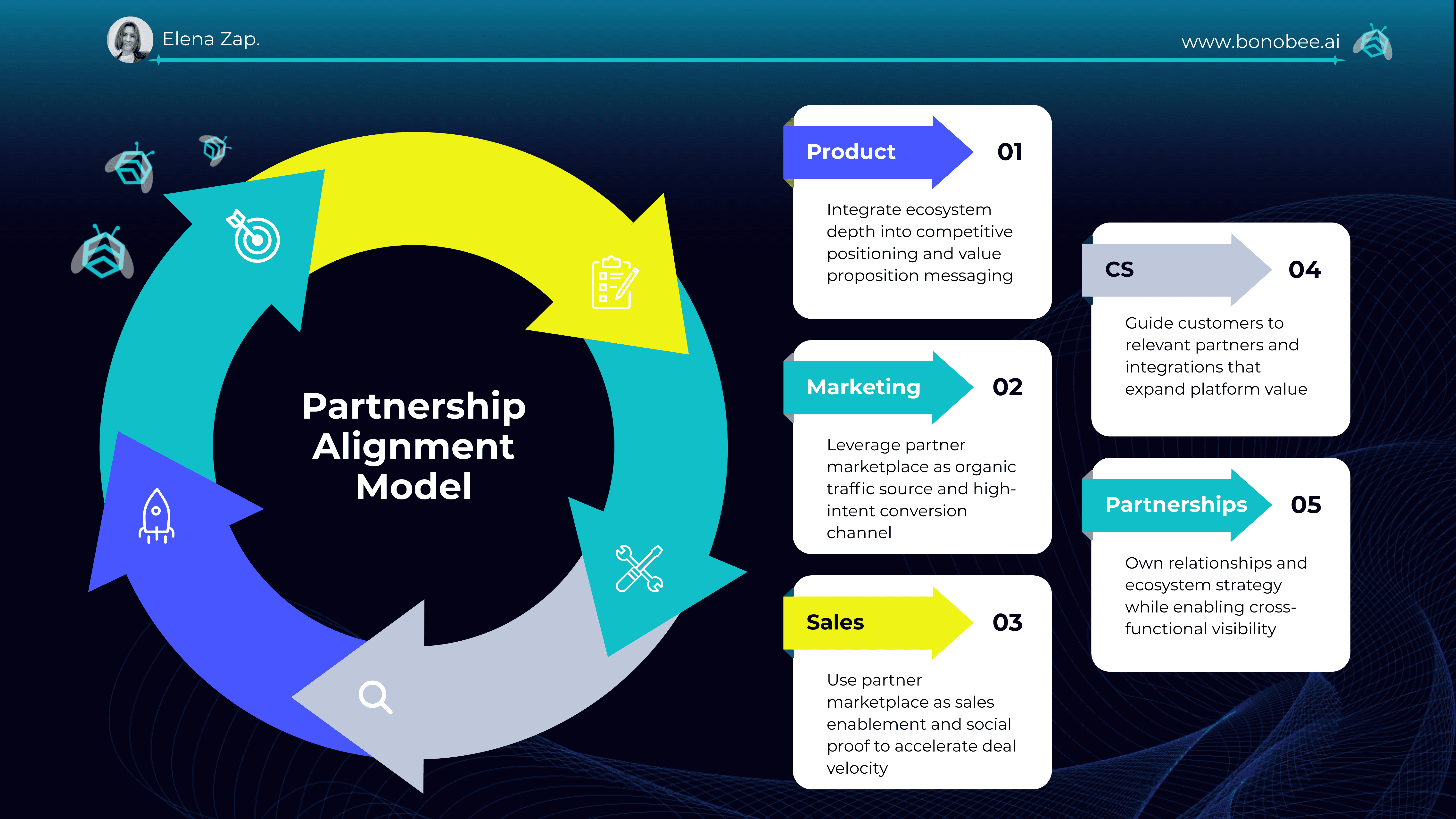
Product teams need to integrate ecosystem depth into competitive positioning and value proposition messaging.
Marketing teams need to leverage partner marketplace as an organic traffic source and high-intent conversion channel.
Sales teams need to use visible ecosystem as proof points in deals and lead with integration capabilities.
Customer Success teams need to guide customers to relevant partners and integrations that expand platform value.
Partnership teams need to own relationships and ecosystem strategy while enabling cross-functional visibility.
When partnerships operate in a silo, the entire company misses the value. Product cannot position ecosystem strength. Marketing cannot generate pipeline from it. Sales cannot prove competitive advantage. Customer Success cannot drive expansion.
The biggest gap exists in marketing infrastructure. While other teams at least acknowledge partnerships matter, marketing has built zero infrastructure to capture ecosystem value as a measurable channel.
The Six Components of Partner Marketing Infrastructure
Building effective partner marketing requires six interconnected elements working together. Each component transforms partner programs from hidden assets into visible growth engines.
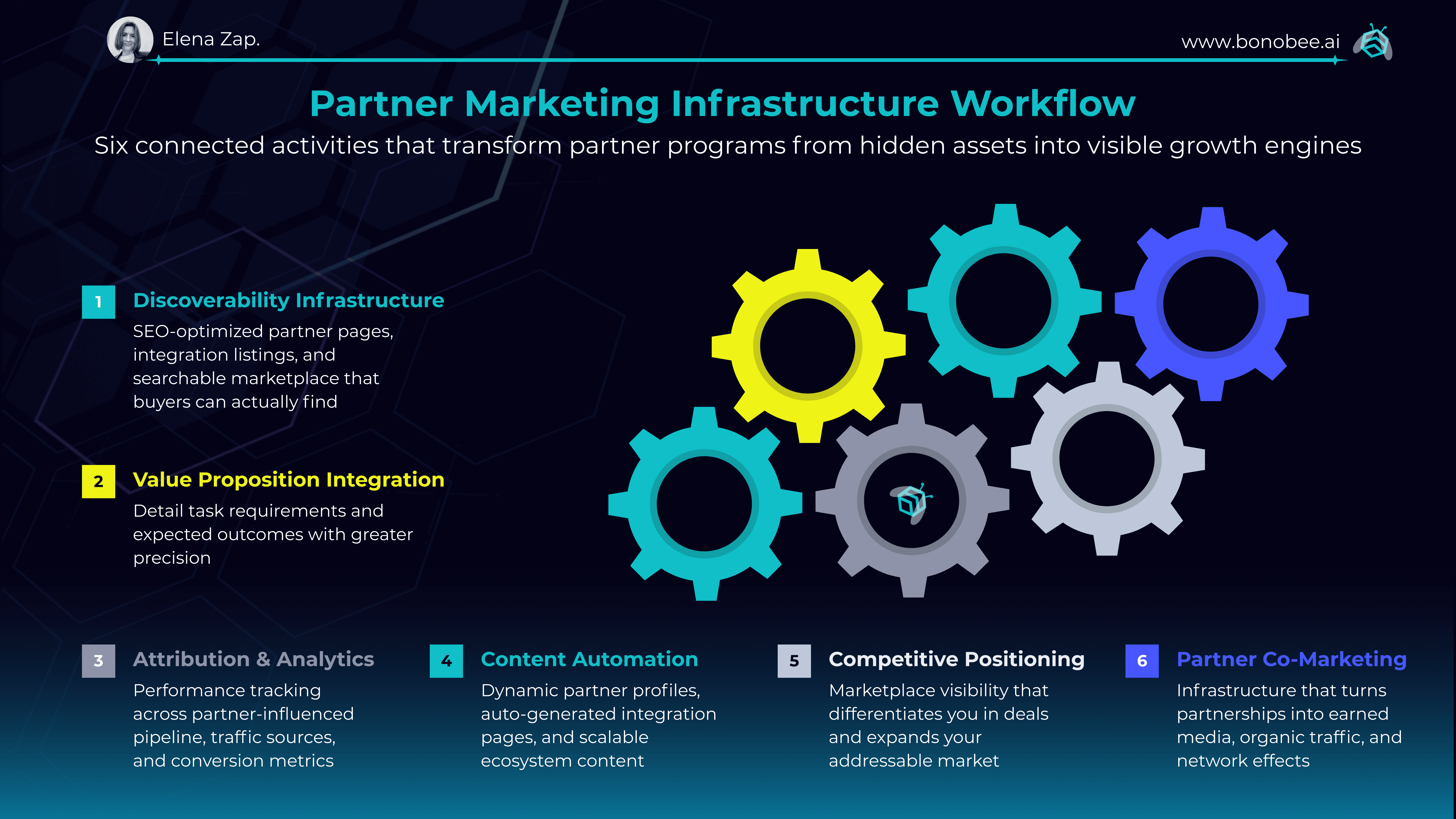
1. Discoverability Infrastructure
What it is: SEO-optimized partner pages, integration listings, and searchable marketplace architecture that makes your ecosystem findable through organic search.
Why it matters: When buyers search for "[your platform] integrations" or "tools that work with [partner name]," they should find your partner marketplace, not generic product pages. Every partner relationship should generate an indexed landing page targeting high-intent integration searches.
Marketing value: Partner marketplace becomes an organic traffic engine. Companies with 50+ partners create 50+ SEO-optimized landing pages without manual content production. This traffic converts at 2-3x standard website rates because visitors arrive with ecosystem intent, not just product curiosity.
Implementation: Solutions like Bonobee address this by providing marketing teams with AI-powered partner marketplace infrastructure that makes ecosystems visible and measurable in weeks, not months.
2. Value Proposition Integration
What it is: Visible ecosystem depth integrated into core competitive positioning and messaging strategies.
Why it matters: Ecosystem breadth is a competitive differentiator, but only if prospects can see it. A visible partner marketplace demonstrates platform maturity and market leadership before sales engagement begins.
Marketing value: Strengthens positioning in competitive deals. Instead of sales explaining "yes, we integrate with that tool," prospects arrive at demos already having seen your 50+ verified integrations. This shifts conversations from feature validation to business outcomes.
3. Attribution and Analytics
What it is: Performance tracking infrastructure across partner-influenced pipeline, traffic sources, and conversion metrics.
Why it matters: Marketing teams cannot optimize what they cannot measure. Partner-influenced revenue currently exists as estimates and anecdotes, not data that guides budget allocation and strategic decisions.
Marketing value: Partner channel finally gets measured like every other channel. Marketing leaders can answer: Which partnerships drive traffic? Which integrations generate inquiries? Which ecosystem connections convert to pipeline? This enables data-driven optimization of partner program investments.
4. Content Automation
What it is: Dynamic partner profile generation, auto-created integration pages, and scalable ecosystem content that updates without manual intervention.
Why it matters: Traditional content creation bottlenecks cannot scale with ecosystem growth. Manual partner page creation requires design resources, copywriting, and ongoing maintenance that becomes impossible at scale.
Marketing value: Partner content scales from 10 partners to 500 partners without linear cost increases. Add a partner, automatically generate an SEO-optimized page. Update partner information, automatically refresh all relevant content. This transforms partner marketing from coordination overhead into automated infrastructure.
5. Competitive Positioning
What it is: Marketplace visibility that differentiates your platform in competitive evaluations and expands addressable market.
Why it matters: Buyers evaluate partner ecosystems before requesting demos. Research shows 87% of technology buyers adjusted their buying process to ensure they only purchase mission-critical solutions that provide ROI. Partner ecosystem evaluation is part of that adjusted process.
Marketing value: Visible ecosystem reduces perceived switching costs, expands ICP to include companies using tools in your ecosystem, and creates differentiation in competitive deals. Marketing captures these advantages through proper infrastructure, not through sales conversations.
6. Partner Co-Marketing Infrastructure
What it is: Systems that turn partnership relationships into earned media, organic traffic, and network effects without constant coordination overhead.
Why it matters: Traditional co-marketing requires extensive coordination: joint webinars, co-branded content, reciprocal promotion agreements. This model doesn't scale and delivers inconsistent results.
Marketing value: Visible marketplaces create automatic co-marketing value. Partners actively promote being in your marketplace because it drives their visibility too. This generates earned media, backlinks, and network effects where strong marketplaces attract more partners seeking visibility.
Why Marketing Teams Haven't Built This Infrastructure
If partner marketing infrastructure delivers clear value, why haven't most marketing teams built it?
The Organizational Silo Problem
Most companies treat partnerships as a single-team responsibility. Partnerships negotiates deals, manages relationships, and reports on ecosystem health. Everyone else treats it as "not my job."
This organizational model made sense when partnerships were supplementary. It breaks down when ecosystems become foundational to go-to-market strategy.
Marketing teams often assume partner visibility is partnerships' responsibility. Partnership teams assume marketing will support with content when needed. The result: nobody owns the infrastructure layer that makes ecosystem value actually capturable.
The Technology Gap
Building proper partner marketing infrastructure requires specialized technology. It's not a feature in existing marketing automation platforms or content management systems.
Marketing teams would need to either:
Build custom infrastructure internally (3-6 months of development, ongoing maintenance)
Cobble together multiple tools that weren't designed for ecosystem marketing
Adopt purpose-built partner marketplace platforms
Most marketing teams lack the technical resources for option one, struggle with the integration complexity of option two, and haven't evaluated option three because partner marketplace platforms are an emerging category.
The Measurement Challenge
Marketing teams excel at measuring channels with clear attribution. Paid advertising tracks click-to-conversion. Content marketing measures organic traffic to pipeline. Event marketing attributes leads to specific conferences.
Partner-influenced pipeline is harder to measure. Did the partnership drive the deal? Did marketing's partner content influence it? Did sales mention the integration? Attribution becomes complex when multiple touchpoints and teams are involved.
Without clear measurement methodology, marketing teams deprioritize infrastructure investments they cannot prove will deliver ROI.
The AI-Powered Solution: Automation Changes Economics
Traditional partner marketing infrastructure required constant manual effort. Every partner page needed copywriting. Every integration listing needed design. Every update required developer resources.
Artificial intelligence changes these economics completely.
How AI Enables Scalable Partner Marketing
Automated content generation: AI generates partner profiles from minimal input, creating SEO-optimized descriptions, value propositions, and integration details without copywriting resources.
Dynamic SEO optimization: AI analyzes search patterns and automatically optimizes partner pages for high-intent queries, adjusting content based on what prospects actually search for.
Intelligent analytics: AI surfaces insights from ecosystem data without requiring analyst time. Which partner types perform best? Which integrations drive most interest? Where are whitespace opportunities?
Scalable maintenance: AI keeps partner information current by monitoring changes and updating content automatically. No manual refresh cycles required.
This automation makes partner marketing infrastructure economically viable at scale. Whether you have 50 partners or 500 partners, the infrastructure handles complexity without linear cost increases.
Most importantly, it gives marketing teams leverage. Instead of being order-takers who create occasional co-branded PDFs, they become operators of a channel that generates measurable pipeline.
The Competitive Advantage Window Is Closing
Right now, most B2B companies still don't have real partner marketing infrastructure. That creates an advantage for early movers.
First-Mover Advantages in Partner Marketing
SEO compounding: Companies building partner marketplaces now capture first-mover SEO advantages on integration and ecosystem searches. These gains compound over time as partner content accumulates and builds domain authority.
Network effects: Visible marketplaces attract more partners. Partners want to be listed where they'll get visibility. Strong marketplaces create gravitational pull that makes partner recruitment easier and ecosystem growth self-reinforcing.
Attribution infrastructure: Companies building measurement systems now establish data advantages that guide strategic decisions. Understanding which partnerships actually drive revenue enables smarter ecosystem investments.
Competitive positioning: Being first in your category with a visible, comprehensive partner marketplace establishes market leadership perception. Later entrants look like followers, even if their actual partner programs are strong.
Market growth: The partner ecosystem platform software market is projected to grow from $85.2B in 2025 to $269.5B by 2035, representing a 12.1% CAGR. This growth reflects the inevitable infrastructure shift happening across B2B.
What Marketing Leaders Need to Do Now
Partner programs won't deliver marketing value until marketing builds infrastructure to capture that value.
The Infrastructure Investment Framework
Step 1: Acknowledge This Is Marketing's Responsibility
Stop treating partner visibility as partnerships' problem. Marketing owns discoverability, attribution, and making value propositions actually visible to prospects. Partnerships owns relationships and ecosystem strategy. Both functions need to operate in their areas of expertise.
Step 2: Audit Current Partner Visibility
Answer these questions honestly:
Can prospects discover your partners through organic search?
Do you measure which partnerships drive pipeline?
Can product marketing position ecosystem depth in competitive deals?
Does your partner content scale with ecosystem growth?
If the answers are no, you have an infrastructure gap.
Step 3: Evaluate Build vs. Buy
Building internally: Requires 3-6 months of development time, ongoing maintenance resources, and technical expertise in SEO, marketplace architecture, and analytics infrastructure.
Buying purpose-built platforms: Provides faster time-to-value, proven best practices, and ongoing feature development without internal resource drain.
Most marketing teams should buy. Development resources are better spent on core product differentiation, not rebuilding infrastructure that already exists in the market.
Step 4: Define Success Metrics
Partner marketing needs the same measurement rigor as every other channel:
Organic traffic from partner marketplace pages
Conversion rates on partner-influenced visitors
Pipeline generated through partner content
Win rates in deals where ecosystem was a factor
SEO ranking improvements on integration searches
Establish baseline metrics, set quarterly targets, and track performance like you would any other marketing channel investment.
Step 5: Build Cross-Functional Workflow
Marketing owns infrastructure. Partnerships owns relationships. Define clear handoffs:
Partnerships negotiates partnership agreements
Marketing ensures partners get discoverable marketplace presence
Partnerships manages ongoing relationship and co-selling
Marketing tracks attribution and optimizes for performance
This separation of responsibilities prevents the organizational dysfunction where nobody owns infrastructure because everyone assumes it's someone else's job.
Infrastructure ROI: Measurable Impact Across Marketing Metrics
While partner marketplace platforms are an emerging category, early adopters demonstrate measurable ROI across multiple dimensions.
SEO and Organic Traffic Impact
Companies implementing partner marketplace infrastructure typically see:
50+ new SEO-optimized landing pages generated from existing partnerships
2-3x conversion rates on partner marketplace traffic vs. generic website traffic
Measurable ranking improvements for "[platform] + [tool]" integration searches
Compounding organic traffic growth as partner content accumulates
Competitive Positioning Improvements
Marketing teams report:
Shortened sales cycles when prospects arrive at demos already aware of integration depth
Reduced objection handling around "does this work with our existing stack"
Improved win rates in competitive evaluations where ecosystem depth matters
Expanded addressable market to companies using tools in the ecosystem
Partner Program Efficiency
Partnership teams benefit from marketing infrastructure:
Reduced time spent coordinating one-off co-marketing initiatives
Stronger partner value proposition ("you'll get marketplace visibility")
Easier partner recruitment when marketplace provides automatic visibility
Better partner retention when visibility drives measurable value
Attribution Clarity
Marketing leadership gains strategic decision-making capability:
Clear data on which partnerships drive pipeline vs. which are "strategic theater"
Ability to optimize partner program investments based on actual ROI
Evidence-based answers to "should we invest in more partnerships or other channels"
Cross-channel attribution showing partner influence on deals
The Strategic Reality: Ecosystem Visibility Is Infrastructure
The fundamental insight driving partner marketing infrastructure adoption: ecosystem visibility is not a campaign, it's infrastructure.
Marketing teams understand this distinction for other channels. Your website isn't a campaign. Your CRM isn't a campaign. Your marketing automation platform isn't a campaign. They're infrastructure that enables ongoing operations.
Partner marketing needs the same treatment.
A visible, searchable, measurable partner marketplace is infrastructure that:
Operates continuously without campaign-level intervention
Generates compounding returns as ecosystem grows
Enables cross-functional leverage across product, marketing, sales, and customer success
Creates competitive advantages that strengthen over time
The companies treating partner visibility as infrastructure establish advantages over companies treating it as a periodic marketing project.
The Complete Partner Visibility Stack
Effective partner marketing infrastructure combines discovery and showcase layers:
Discovery layer (Partner2B): Makes partner programs findable when companies actively search for partnership opportunities. Critical for partner recruitment and inbound partnership pipeline.
Showcase infrastructure (Bonobee): Provides owned marketplace platforms for companies with mature ecosystems (50+ partners), enabling professional ecosystem presentation with searchable directories, partner profiles, and integration catalogs.
Analytics layer: Tracks attribution, measures performance, and optimizes partner marketing as a revenue channel.
This three-layer approach ensures both sides of the partnership equation: attracting partners to your program and showcasing your ecosystem to customers.
Strategic Takeaway: Marketing Must Own Ecosystem Visibility
B2B buying behavior has fundamentally shifted. Buyers evaluate ecosystems, not just products. Partner depth influences purchase decisions. Integration capabilities affect platform adoption.
Your ecosystem is part of your value proposition now.
But that ecosystem only creates competitive advantage if it's actually visible to prospects. And making it visible, measurable, and scalable is marketing work, not partnerships work.
The infrastructure gap exists because organizational models haven't caught up to market reality. Companies built structures when partnerships were supplementary and haven't updated them now that ecosystems are foundational.
Marketing teams have the skills needed: SEO expertise, content operations, attribution modeling, conversion optimization. What they're missing is infrastructure purpose-built for partner marketing.
The strategic question isn't whether to build partner marketing infrastructure. The question is whether you build it before your competitors do.
The companies building that infrastructure now establish first-mover advantages in SEO, competitive positioning, and attribution clarity. The companies waiting are losing deals to competitors with visible ecosystems.
Your ecosystem is part of your value proposition. Marketing needs to own making it work.
Continue Learning About Partner Marketing
The Partner-Led Revolution: 13 B2B Trends Driving Ecosystem Growth & Sales in 2025
The Partner-Led Growth Playbook: KPIs, Metrics, and Signals That Prove It's Working
Ready to build partner marketing infrastructure? Partner2B helps companies make their partner programs discoverable, while Bonobee provides marketplace infrastructure for companies with mature ecosystems.